Is Mobile Paintless Dent Repair Right for Your Vehicle?
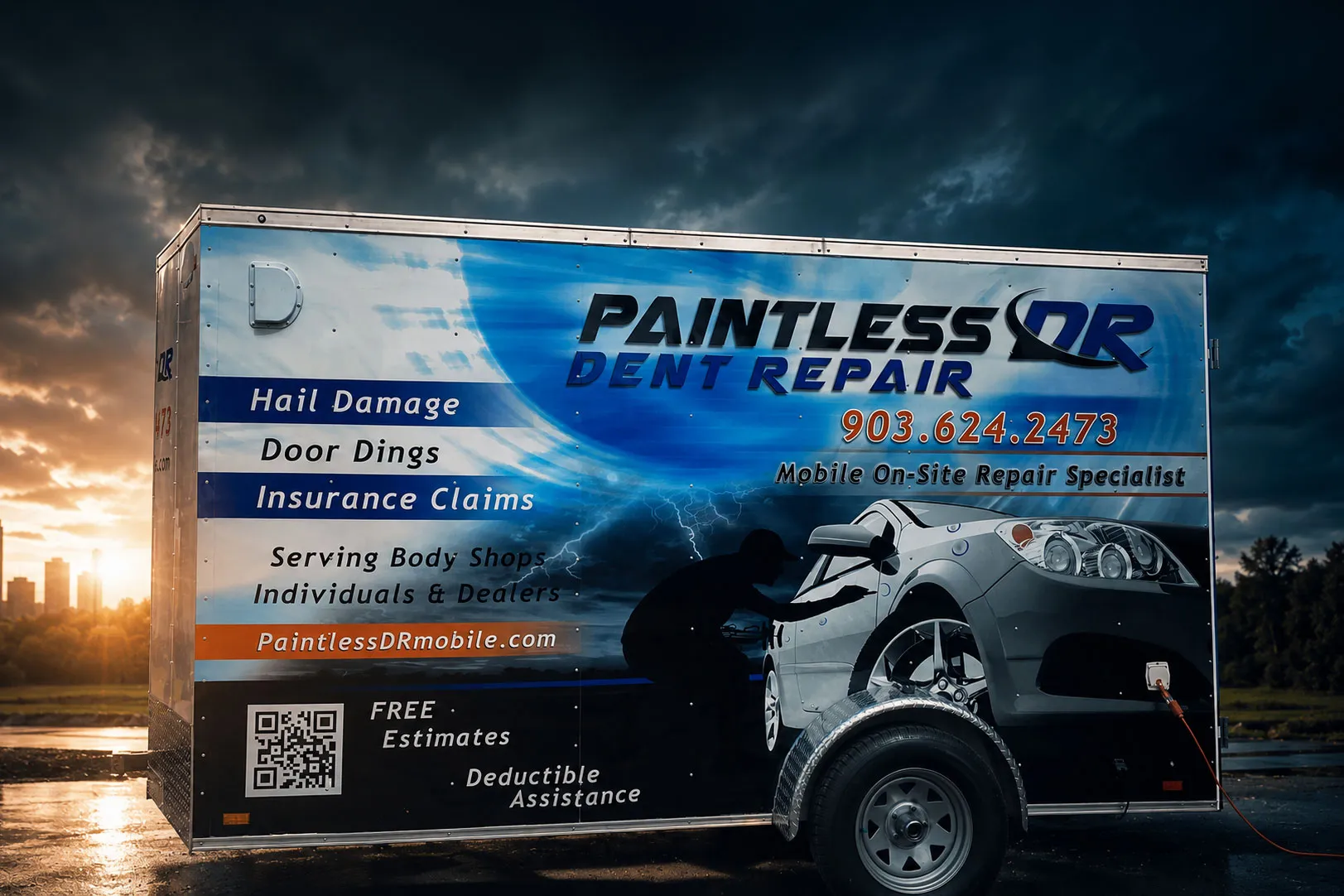
Automotive body repair has undergone a quiet revolution over the past few decades. Gone are the days when every dent required sanding off your vehicle's factory clear coat, filling the indentation with plastic Bondo body filler, and spraying aftermarket paint. Today, Paintless Dent Repair (PDR) can resolve a massive percentage of everyday vehicle damage on-site at your home or office.
But is PDR the right choice for your specific vehicle and dent? Understanding what makes a dent a good candidate for paintless restoration can save you thousands of dollars and weeks of vehicle downtime.
The Three Key Criteria for PDR Suitability
To determine if your vehicle's damage can be repaired paintlessly, a technician will evaluate three primary factors:
1. Paint Condition
The absolute number-one rule of PDR is that the paint finish must be intact. If the impact that caused the dent also chipped, cracked, scraped, or flaked the paint down to the metal or primer, PDR alone cannot fully restore the panel. However, if the paint is scratched but not cracked, we can often massage the dent out first, then professionally polish the surface to make the scratch disappear.
2. Metal Stretch and Depth
Metal behaves like a spring. Under normal denting force, it flexes out of shape. If the dent is shallow, rounded, or even creased, the metal can be massaged back into position. However, if the dent is extremely deep, sharp, and pointed, the metal at the center of the dent may have stretched beyond its physical limit. Stretched metal has excess surface area, making it difficult or impossible to return to a flat panel without body shop repainting.
3. Access and Structural Obstructions
To perform PDR from the inside out, the technician needs to slide a tool behind the dent. While our tools are incredibly thin and curved to slide down window tracks and under trim panels, some areas are structurally obstructed. For example, if a dent is directly on the edge of a door panel (where the outer metal skin is crimped to the inner frame) or behind a double-walled reinforcement brace, backside access is blocked. In these cases, we often use advanced glue-pulling systems from the outside.
When is PDR NOT Suitable?
While PDR is incredibly versatile, it is not a magic wand. PDR is not suitable for:
- Deep collision damage where panels are heavily crushed or torn.
- Dents with cracked or missing paint where rust has begun to form.
- Dents on chrome bumpers or composite plastic body panels.
- Areas where the metal is double-walled with no glue-pulling access.
Frequently Asked Questions
Can you repair a dent if the paint is scratched? ➔
Yes, but with limitations. If the paint is lightly scratched or scuffed on the surface but has not cracked or flaked down to the primer or bare metal, we can massage the dent out first, then polish the scratch away. If the paint is chipped, cracked, or missing, traditional repainting or touch-up paint is required.
Do you need access to electricity or a garage for mobile dent repair? ➔
Our mobile units are fully self-powered. However, direct sunlight can distort the reflection of our LED boards, so working in a garage, carport, or shaded driveway is highly preferred. If shade isn't available, we can set up temporary pop-up canopies.
Are there any types of cars you cannot perform mobile dent repair on? ➔
PDR can be performed on almost any passenger vehicle, including steel-bodied and aluminum-bodied cars, trucks, SUVs, and electric vehicles (EVs). We also work on high-end luxury vehicles and classic collector cars, provided the paint is original or of high repaint quality.